Emotional intelligence & EQ-i 2.0
Dare to feel
For a long time it was thought that someone with a high IQ would automatically be happy. This, however, is not always the case. The difference has to do with a person's emotional intelligence. Scientific research shows that a high EQ offers a greater chance of a successful life than a high IQ. Emotional skills are the most important keys to 'success': whatever that looks like for you. Empathy is one of the pillars of emotional intelligence, alongside emotional self-awareness. Being able to put yourself in another's shoes, without judgement, requires finding that part of yourself where you can connect.
Emotional intelligence is measurable! No. 1 worldwide: EQ-i 2.0
The wonderful thing is that you can develop these emotional skills! The foundation is learning to recognise emotions. Many of my clients lead a successful career on the outside. But at some point they get stuck. Some of the 'heavier' emotions they have learned to deny from a young age, developing several coping mechanisms in the process. Until the shelf life has expired. Broadening and developing your spectrum of feelings further is the foundation of emotional intelligence, and that brings calm and space.
Emotional intelligence and agility
We live in a time of rapid change that challenges our old beliefs. These sometimes come with feelings of despair or powerlessness. The belief, for example, that if you just work hard enough, success and happiness will come to you of their own accord. And that if this does not happen, it is entirely down to you. Agility and 'emotional agility' are more valuable than ever. We constantly make trade-offs based on feelings and emotions. When we do this (more) consciously, we recognise our drives and ambition sooner, learn to deal differently with setbacks and strengthen our resilience. Emotionele intelligentie is dit alles en nog meer!
Assess. predict. perform.
Scientific basis
Emotional intelligence, measured with the EQ index, is a complement to the traditional IQ. When John Mayer and Peter Salovey developed a theory in 1989 that brought together the concept of 'intelligence' with emotions, the idea of 'emotional intelligence' was born. Not long afterwards came the book of the same name by the American Daniel Goleman. In accessible language he explained the importance of EQ, or the 'emotional quotient'. He showed for the first time that emotional skills, more than (only) rational ones, are decisive for a successful career. To this day he publishes regularly on this subject.
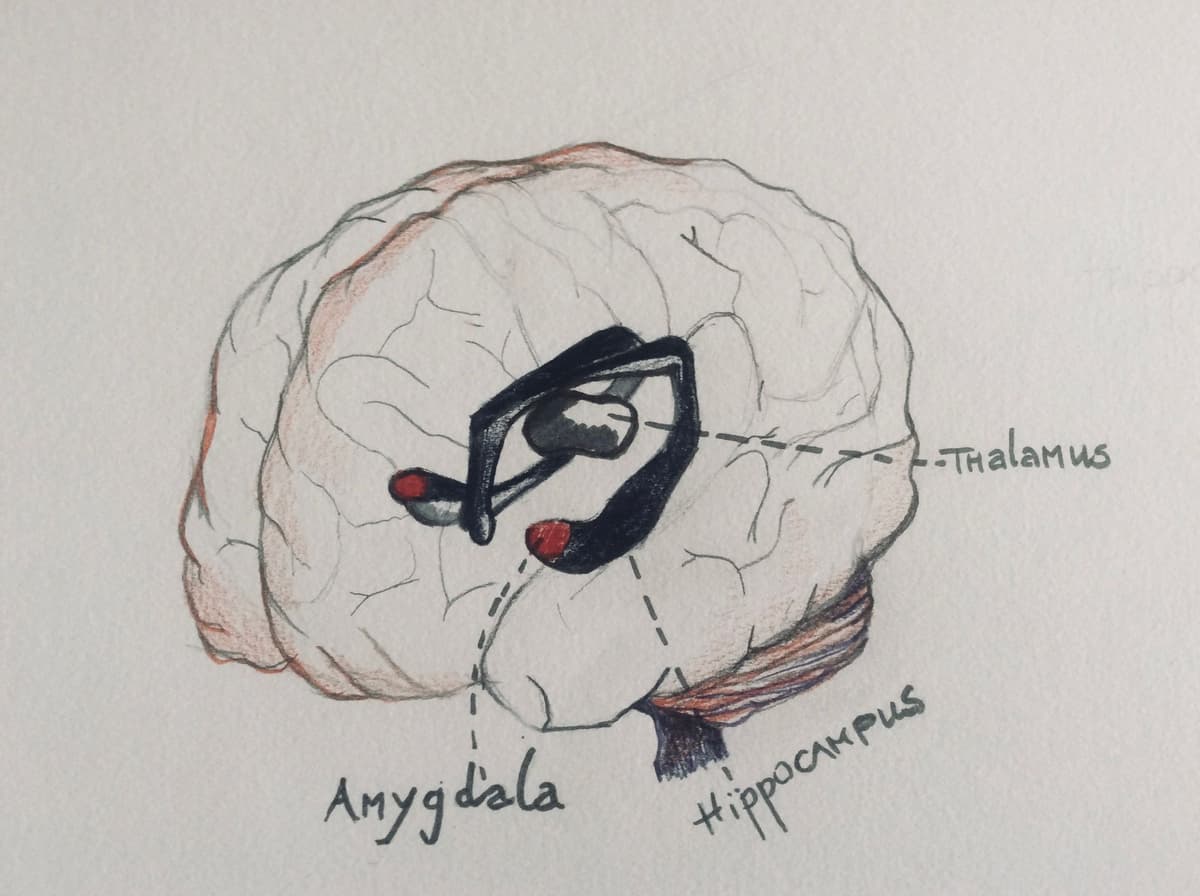
Illustration: Valérie Docters Verswijveren
The amygdala makes connections between information from different senses and links it to emotions. Its role in fear responses in particular is well known.
Dr. R. Bar-On developed the first reliable assessment instrument for MHS to measure emotional intelligence. The EQ-i 2.0 from the Canadian company MHS is the successor, based on renewed scientific insights and the largest publisher of clinical assessments: Pearson Clinical Benelux. These tests are used in coaching journeys for managers, employees, 360, departments and teams, and are often part of HRM in staff selection. What makes it interesting for international companies, organisations and expats is that the test can be taken in several languages.