
Communication
Everything is communication: how do we give it direction?
Are you told that you are assertive but not always tactful? Or that you could be clearer, more visible? All day long we are communicating. If not with the outside world, then with ourselves. Why do we so often find it difficult to truly understand one another? Or to confront each other respectfully and avoid passive-aggressiveness as much as possible? Bringing our own needs into balance with those of others asks quite a lot. It means being aware of your own assumptions, values and feelings, and aligning them with the visible and audible interaction.
As a professional coach with a background as Marketing & Communications Manager, I bring my experience and qualities to bear with sharp observation and stimulating, humorous feedback, with plenty of attention for a reliable foundation.
'Nonviolent communication' + Leary's Rose
Before I started as a coach, I followed the training 'Nonviolent Communication', based on the ideas of Marshall B. Rosenberg. The title may be amusing, but it is also about something real. If models still have meaning after three quarters of a century, that says something. In the foreword of the book (published by Lemniscaat), Arun Gandhi writes the following: '...He, [VDvL: the legendary Mahatma Gandhi] made me see that violence dwells in all of us, and that we must therefore change our attitude. Often we do not acknowledge it because we are not aware of it. We assume we are not violent because we associate violence with fighting, killing, hitting and waging war, things the average person does not do'. Working with 'nonviolent communication' teaches you which needs lie beneath behaviour, with the following view: 'You are 100% responsible for 50% of the contact'.
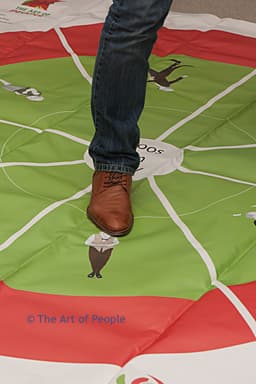
Alongside 'nonviolent communication', the interaction model the Leary's Rose is also used. Which communication styles do you prefer and show most? Are these effective in your contact with clients and colleagues? With the Leary's Rose you have 8 communication styles, each with its own function. When you can deploy the whole palette where needed, this increases your effectiveness. For departments too it is a powerful instrument for exploring how you can truly collaborate while respecting each other's differences.
Interpersonal Profile®: the scientific test of the Leary's Rose
The validated interaction test of the Leary's Rose, the IPP, is a valuable instrument for measuring personal and team communication skills. The Art of People is, with a small group in the Netherlands, the only one to use the layered nature of the Leary's Rose and not just the level of behaviour. The test was developed in collaboration with the University of Nijmegen. Based on 128 questions, it accurately shows the preferences of 8 preferred styles. We get to work on the following questions: