
Team coaching and group supervision
How do you create the team's capacity to learn?
A group of people is not yet a team, as we now know. But how do you turn your department into a vital team that collaborates better and better? And what does that ask of you as a leader? Team coaching clarifies expectations and works on shared development. Among the fifteen competencies experienced as most valuable are 'Empathy', collaboration: 'Interpersonal relationships', the balance between self and other: 'Assertiveness + Self-regard' and 'Social responsibility'.
Bring to light which organisational, team and personal values matter to you, in combination with the mandate you have from society, the client and the organisation (employees!). Create connection(s) and clarify mutual communication. A lot still goes wrong through miscommunication and a lack of trust. Strong business results also come from investing in human values and attention for the 'soft skills'.
The EQ-i 2.0® offers insight into the 15 most valuable competencies that also underpin close collaboration. Based on an individual profile, an (anonymous) group profile is compiled. This allows you to discuss the results confidentially and work on forming a team. Important competencies such as 'Empathy', 'Interpersonal relationships' and 'Optimism' are some of them. The EQ-i 2.0®, incidentally, is not about unbridled growth; the possible shadow sides are highlighted too. A higher Self-regard (the 'risk of being high'), for example, can tip over into arrogance. Linked to the question and to the group or team, meaning is given together to the test results and the development question.
Politically coloured culture
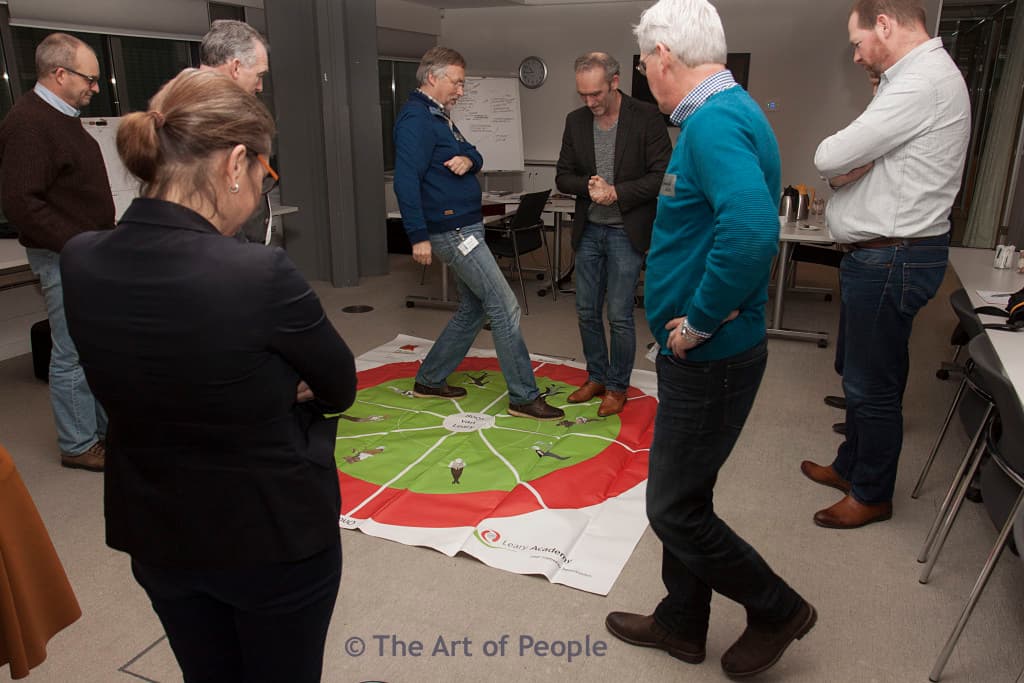
In governments, but also in companies and organisations, there is often a 'politically coloured culture' at various levels. The well-known interaction model the Leary's Rose is highly suitable for mapping interaction movements and seeing which interaction styles are underexposed. Since 2010 there has been the validated Interpersonal Profile IPP® Leary's Rose. Valérie Docters van Leeuwen took part in the pilot and is one of the few in the Netherlands to work on the deeper layers, including the layer of values, alongside the widely known visible behaviour. A training actor from Kapok was used here.
With the IPP Leary's Rose you get an accurate profile of the department and/or team. What is the profile, what is the non-verbal communication, red, green or white behaviour? What underlying values are there, unspoken convictions and... traumas too? Many people bring their personal traumas with them: this happens at every level and in every role. Coaching and supervision are not therapy; but within boundaries a great deal can be discussed, provided there is safety.
The Art of People c&c guides departments and teams towards vital collaboration. Obstructive patterns that get in the way of organisational results are made visible. You learn to gain insight into each other's differences, mental models and ways of communicating.
Two example situations:
The Art of People c&c has successfully guided several departments and teams:
'Team exercises, keeping a logbook of learning points and insight into each other's qualities and vulnerabilities have ensured that the team has taken significant steps forward. Trust and collaboration in particular have visibly improved.'Alex Griffioen, Regional Director Hospitality Sales, Heineken Netherlands
'Initially we hired The Art of People to organise a fun team day as a basis for improving and strengthening the team bond. It soon turned out, however, that Valérie Docters van Leeuwen could and can mean more for us in terms of content. This resulted, and still results, in a coaching journey for the people, working groups and manager, with the central theme: learning to collaborate in and as a team, in which everyone recognises their role, takes responsibility and functions better. Valérie makes contact easily, quickly gets to the core and knows how to get people 'moving' in a pleasant way. What I first thought would take another year, we achieved with Valérie in a few months.'Rob Goedegebuur, Head of Internal Sales, Holcim Betonproducten BV